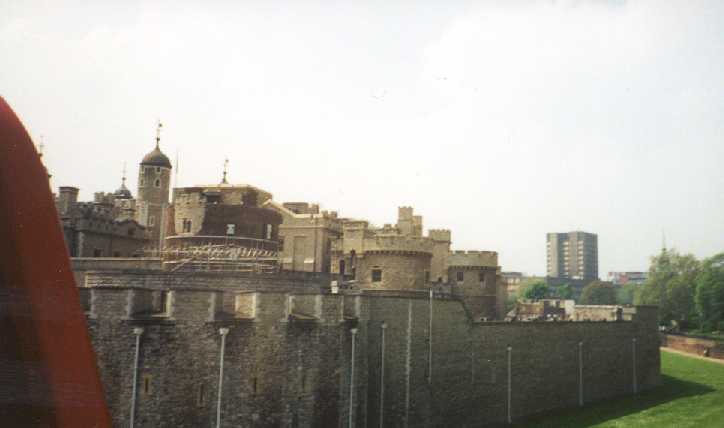
 This is the view from outside the Tower of London. Contrary to the picture
its name presents, the Tower is actually a collection of buildings surrounded by
the Thames River on one side, and think, brick walls on the other three.
This is the view from outside the Tower of London. Contrary to the picture
its name presents, the Tower is actually a collection of buildings surrounded by
the Thames River on one side, and think, brick walls on the other three.
For centuries, there has been a military presence at the location of the Tower of London. First, it was a fort. Then, it was a royal residence for England's early kings. Then, later rulers converted it for the purpose it has the most fame for: prison. The Tower of London has seen famous political prisoners and common riff raff alike. For many of these people, the Tower was a last stop on the way to meet the executioner. There's some great stories associated with the Tower. I have some of them here, but there's many more at http://www.tower-of-london.com/
This is the view from outside the Tower of London. Contrary to the picture
its name presents, the Tower is actually a collection of buildings surrounded by
the Thames River on one side, and think, brick walls on the other three.
 This is shot of the moat of the Tower. This moat was at one time filled
with water, and served as one of many deterrents both to people wanting to get
in and people wanting to get out. The moat was added in the late 1100's by
Richard I and fed from the Thames River. Now that the Tower isn't a prison
anymore, there's a soccer field on the grass of the moat. When the moat
was drained in 1830, they found hundreds of human bones.
This is shot of the moat of the Tower. This moat was at one time filled
with water, and served as one of many deterrents both to people wanting to get
in and people wanting to get out. The moat was added in the late 1100's by
Richard I and fed from the Thames River. Now that the Tower isn't a prison
anymore, there's a soccer field on the grass of the moat. When the moat
was drained in 1830, they found hundreds of human bones.
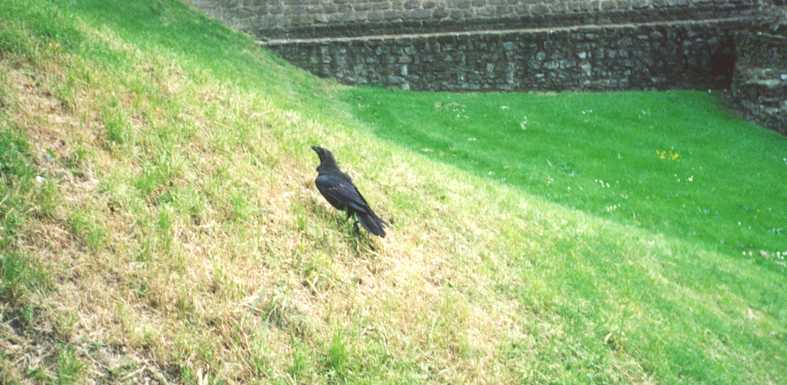 This is a raven. Why is a raven in with my Tower of London pictures?
Well, its a strange story. Ever since the Tower was built, there have been
ravens living at the Tower. The guards of the Tower, called beefeaters,
took to caring for the birds, the one that specializes in raven care is called
the Raven master. At some point, there was a prophecy made that if the
ravens ever left the Tower, the monarchy would fall. Now, being that this
is the 21st century, we're past all that silliness right? Wrong. The
ravens have their wings clipped. These birds ain't goin' nowhere.
Guess the monarchy is safe.
This is a raven. Why is a raven in with my Tower of London pictures?
Well, its a strange story. Ever since the Tower was built, there have been
ravens living at the Tower. The guards of the Tower, called beefeaters,
took to caring for the birds, the one that specializes in raven care is called
the Raven master. At some point, there was a prophecy made that if the
ravens ever left the Tower, the monarchy would fall. Now, being that this
is the 21st century, we're past all that silliness right? Wrong. The
ravens have their wings clipped. These birds ain't goin' nowhere.
Guess the monarchy is safe.
 This is where the ravens live. From what I could tell, they come and go as
they please, but they're locked in at night. The beefeater giving the tour
told us to stay off the grass. Ravens are very territorial, and they're
mean as hell. They decide they don't want you near them, they'll tear you
up. That wall right behind the raven cages was built by the Romans -
almost everyone who has controlled London has had a fortification of some sort
on this location
This is where the ravens live. From what I could tell, they come and go as
they please, but they're locked in at night. The beefeater giving the tour
told us to stay off the grass. Ravens are very territorial, and they're
mean as hell. They decide they don't want you near them, they'll tear you
up. That wall right behind the raven cages was built by the Romans -
almost everyone who has controlled London has had a fortification of some sort
on this location
 This is the Bloody Tower. It's called the Bloody Tower because this is
where many of the condemned were kept before being led to the gallows to be
executed.
This is the Bloody Tower. It's called the Bloody Tower because this is
where many of the condemned were kept before being led to the gallows to be
executed.
 This is the White Tower. This is the building that lent the
"Tower" name to the facility as a whole. This held much of the
kings armory, the storehouse of military weapons and records. Later on,
the White Tower was used to store records.
This is the White Tower. This is the building that lent the
"Tower" name to the facility as a whole. This held much of the
kings armory, the storehouse of military weapons and records. Later on,
the White Tower was used to store records.
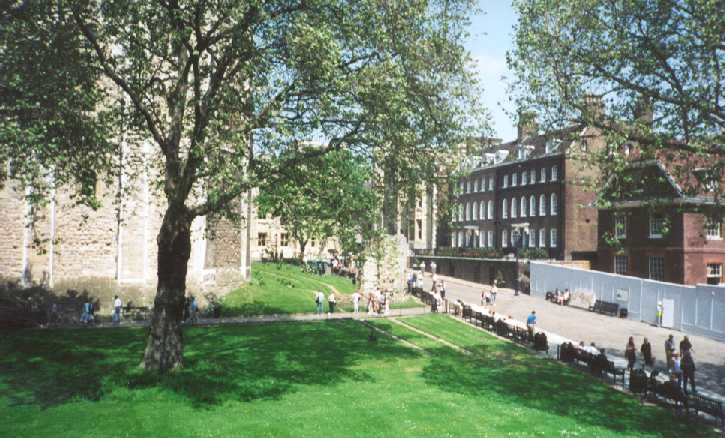 This a view of the courtyard from the White Tower. This is the view that
many condemned men and women saw during their last days. Without the park
benches and paved walkways, of course.
This a view of the courtyard from the White Tower. This is the view that
many condemned men and women saw during their last days. Without the park
benches and paved walkways, of course.
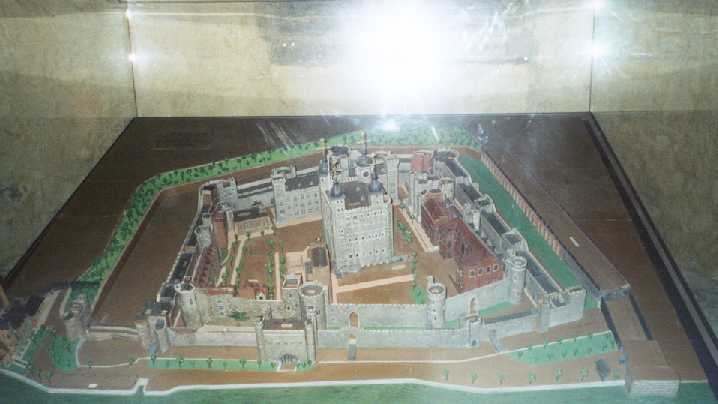 This is a model of the Tower as it would have appeared during the reign of Henry
VIII, who used the Tower as a prison more extensively than any other ruler.
The big tower in the middle is the White Tower. The Bloody Tower is just
to the upper right of the White Tower.
This is a model of the Tower as it would have appeared during the reign of Henry
VIII, who used the Tower as a prison more extensively than any other ruler.
The big tower in the middle is the White Tower. The Bloody Tower is just
to the upper right of the White Tower.
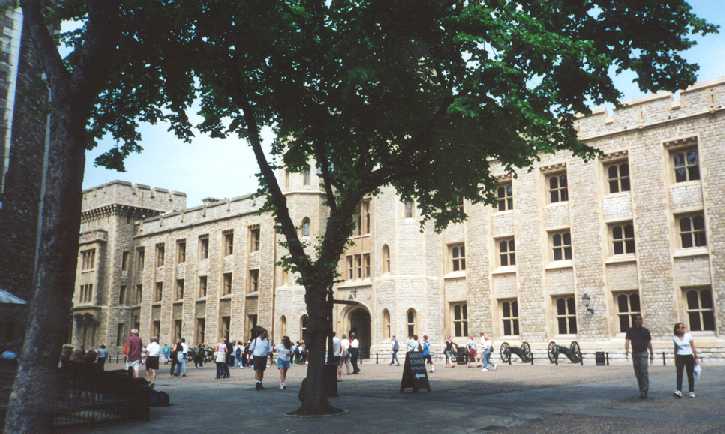 On of the things that the Tower of London is most famous for is the Crown
Jewels, the crowns, tiara's, and decorations that the various rulers of England
have worn and continue to wear down through the ages. They don't allow
photography of the jewels themselves, but this is the building they're in
On of the things that the Tower of London is most famous for is the Crown
Jewels, the crowns, tiara's, and decorations that the various rulers of England
have worn and continue to wear down through the ages. They don't allow
photography of the jewels themselves, but this is the building they're in
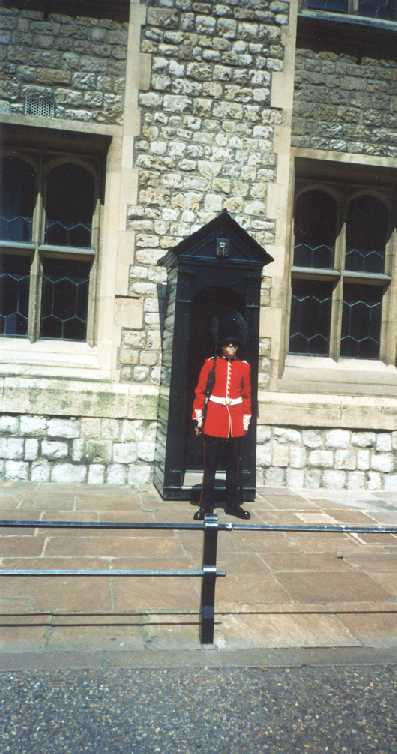 This is the guard outside the Crown Jewels room. There's a lot of money in
there, I guess it makes sense to have a guard. That gun he has is a real
rifle,
This is the guard outside the Crown Jewels room. There's a lot of money in
there, I guess it makes sense to have a guard. That gun he has is a real
rifle,
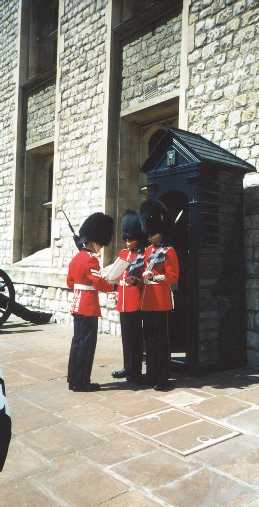 This is the changing of the guard ceremony. Its much simpler here than at
Buckingham Palace (it takes over an hour there, and involves all sorts of
horses, bands, all kinds of stuff). Here, the commanding officer just asks
the old guard, "anything happen?" He says, "Yeah, a bunch
of kids stared at me, and all kind of silly Americans took my picture (see
above)." The commander says, "OK good, you're off
duty." Then he tells the new guard, "you're on duty, don't get
the Crown Jewels stolen or its your arse."
This is the changing of the guard ceremony. Its much simpler here than at
Buckingham Palace (it takes over an hour there, and involves all sorts of
horses, bands, all kinds of stuff). Here, the commanding officer just asks
the old guard, "anything happen?" He says, "Yeah, a bunch
of kids stared at me, and all kind of silly Americans took my picture (see
above)." The commander says, "OK good, you're off
duty." Then he tells the new guard, "you're on duty, don't get
the Crown Jewels stolen or its your arse."
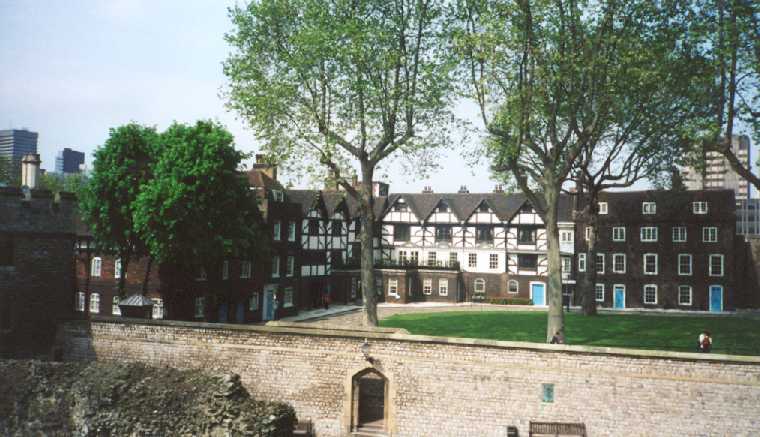 This is the warden's residence. The Tower is still an active military
installation, and the guards are real soldiers with real guns. There's a
guard in this picture, can you find him?
This is the warden's residence. The Tower is still an active military
installation, and the guards are real soldiers with real guns. There's a
guard in this picture, can you find him?
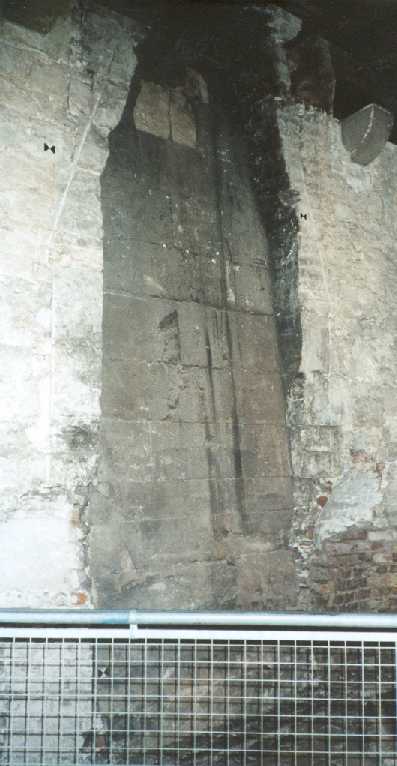 This is in one of the outer towers - its the remains of a fireplace that was
built in the 10 Century, when the current Tower was built.
This is in one of the outer towers - its the remains of a fireplace that was
built in the 10 Century, when the current Tower was built.
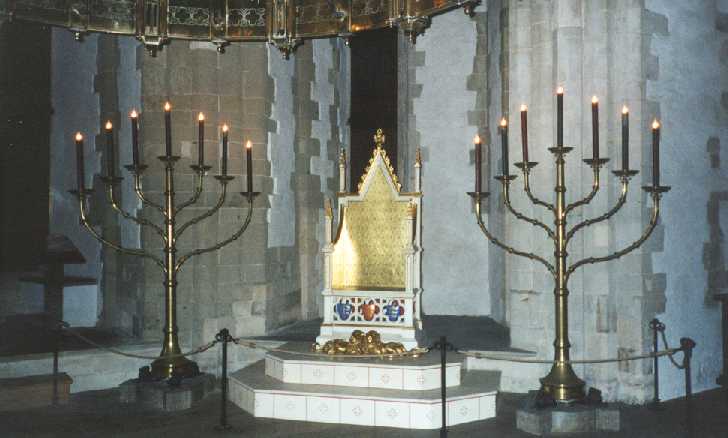 This is one of the early thrones of England. For a short time, the Tower
of London was the primary residence of the King. In the room next to the
throne room, there's a plaque that says something like, "here was struck
down King ??? (I forget the name) by an assassin as he prayed." Bad
way to go.
This is one of the early thrones of England. For a short time, the Tower
of London was the primary residence of the King. In the room next to the
throne room, there's a plaque that says something like, "here was struck
down King ??? (I forget the name) by an assassin as he prayed." Bad
way to go.
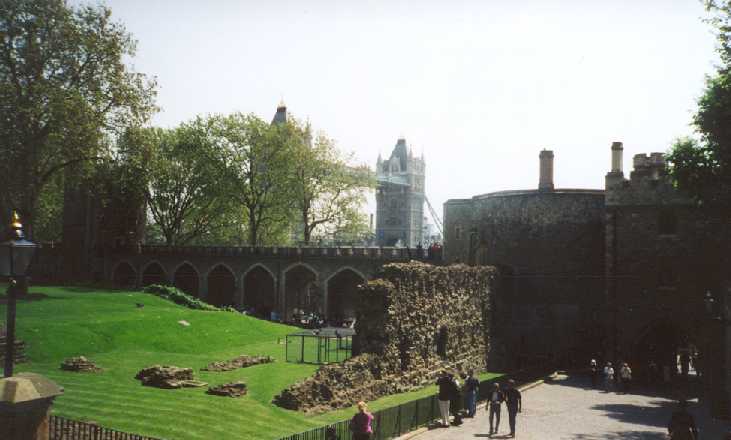 This is another shot of the courtyard, but this one has a better view of the
wall built by the Romans. You can also see part of Raven Central.
And way in the background is Tower Bridge, one of the many bridges that cross
the Thames River.
This is another shot of the courtyard, but this one has a better view of the
wall built by the Romans. You can also see part of Raven Central.
And way in the background is Tower Bridge, one of the many bridges that cross
the Thames River.
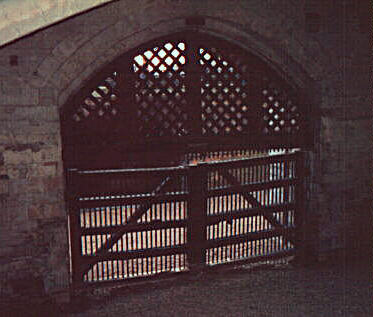 This is the Traitors Gate. This is the gate through which prisoners were
often brought to the Tower. It opens right onto the Thames River.
That way, the boat with the prisoner on it could pull right into the Tower.
This is the Traitors Gate. This is the gate through which prisoners were
often brought to the Tower. It opens right onto the Thames River.
That way, the boat with the prisoner on it could pull right into the Tower.
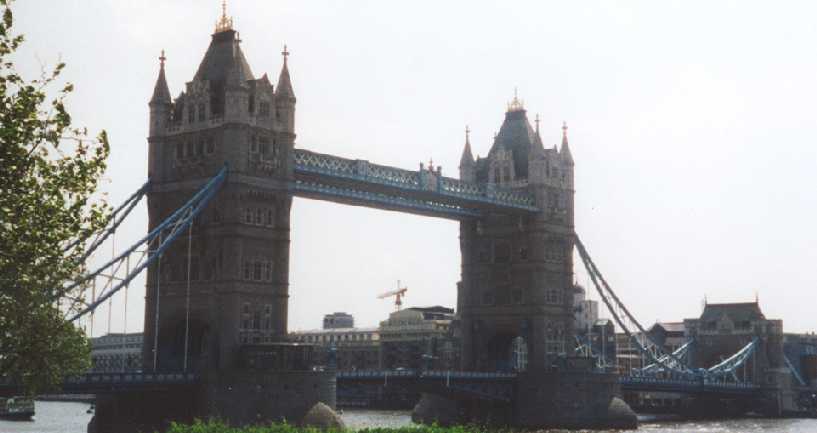 This is Tower Bridge, just outside the Tower. Tower Bridge was where they would stick the heads of the
executed people on a pole as a warning to others. Kind of makes for an
interesting mental picture, doesn't it? You're walking down the bridge,
and on either side of you is all these severed heads. And they didn't take
them down, they just rotted up there, until they were stolen or the wind knocked
them into the river.
This is Tower Bridge, just outside the Tower. Tower Bridge was where they would stick the heads of the
executed people on a pole as a warning to others. Kind of makes for an
interesting mental picture, doesn't it? You're walking down the bridge,
and on either side of you is all these severed heads. And they didn't take
them down, they just rotted up there, until they were stolen or the wind knocked
them into the river.
 This is actual battle armor worn by Henry VIII (the one who had the nasty habit
of having his wives' heads cut off). Henry VIII was an exceptional athlete
in his youth, and was a very good horseman. It wasn't until he became king
that he got fat.
This is actual battle armor worn by Henry VIII (the one who had the nasty habit
of having his wives' heads cut off). Henry VIII was an exceptional athlete
in his youth, and was a very good horseman. It wasn't until he became king
that he got fat.
 Ah, and what Medieval prison would be complete without a chopping block?
This is where the Tower's was. However, only 8 people were executed
here. Most of the people who were executed from here were taken to a hill
nearby called Gallows Hill. It was much easier for the people to watch the
executions. The only people executed here were royalty, mostly Henry
VIII's wives. Anne Boleyn, his 2nd wife got the axe here. His 4th (I
think) wife, Catherine Howard, was executed here too. Catherine was
French, and requested that she be executed French style, with a sword instead of
an axe. Since there was no one in England skilled enough with a sword to
perform the deed, Henry VIII sent to France for a French executioner (what a
guy!) So, ol' Catherine was kneeling there praying and the executioner
winds up and whoosh!! One swipe, and her head comes neatly off. As
was the custom, he picked the head up to show to the onlookers. Much to
everyone's dismay, Catherine Howard's eyes were still blinking, and her lips
were still moving. It isn't known if that was some sort of death spasm, or
if she was still conscious for a few seconds after her head came off. Nice
story, eh? Another person who bought it here was Lady Jane Grey, who was
Queen of England for 9 days. Seems after Edward (son of Henry
VIII) died, some Duke claimed that his daughter had the best claim to the throne
and put the crown on her head. Mary Tudor (daughter of Henry VIII)
took exception to that, and wrestled power away from the Duke and his poor
daughter. So, the Duke got his on Gallows Hill, and the 17 year old Jane
Grey got the choppy choppy here in the Tower a few days later. But first,
they sent her young husband out to Gallows Hill to get his own neck
severed. She got to watch through her window as they drug him from the
Tower, and could hear the roar of the crowd as the executioner picked up his
head and showed it to the crowd. I think that was pretty crappy of her dad
to put her in that position. And last but certainly not least (of the
stories I like the best - like I said, there's more at http://www.tower-of-london.com/)
is the story of Margaret Pole the Countess of Salisbury. She was executed
in 1541. Seems her son was a Catholic cardinal, and he took potshots at
the religious reforms of Henry VIII from the safety of France. Since Henry
couldn't shut up the good cardinal, he decided to take out his 70 year old
mother instead. However, the Countess decided that she wouldn't go
quietly, so she took to running around the scaffolding, making the executioner
chase her until he finally hit her with the axe enough times that she lost consciousness,
so he could finish her proper. Anyway, that chapel behind the chopping block
is where several of the people who lost their heads in the Tower are buried.
Ah, and what Medieval prison would be complete without a chopping block?
This is where the Tower's was. However, only 8 people were executed
here. Most of the people who were executed from here were taken to a hill
nearby called Gallows Hill. It was much easier for the people to watch the
executions. The only people executed here were royalty, mostly Henry
VIII's wives. Anne Boleyn, his 2nd wife got the axe here. His 4th (I
think) wife, Catherine Howard, was executed here too. Catherine was
French, and requested that she be executed French style, with a sword instead of
an axe. Since there was no one in England skilled enough with a sword to
perform the deed, Henry VIII sent to France for a French executioner (what a
guy!) So, ol' Catherine was kneeling there praying and the executioner
winds up and whoosh!! One swipe, and her head comes neatly off. As
was the custom, he picked the head up to show to the onlookers. Much to
everyone's dismay, Catherine Howard's eyes were still blinking, and her lips
were still moving. It isn't known if that was some sort of death spasm, or
if she was still conscious for a few seconds after her head came off. Nice
story, eh? Another person who bought it here was Lady Jane Grey, who was
Queen of England for 9 days. Seems after Edward (son of Henry
VIII) died, some Duke claimed that his daughter had the best claim to the throne
and put the crown on her head. Mary Tudor (daughter of Henry VIII)
took exception to that, and wrestled power away from the Duke and his poor
daughter. So, the Duke got his on Gallows Hill, and the 17 year old Jane
Grey got the choppy choppy here in the Tower a few days later. But first,
they sent her young husband out to Gallows Hill to get his own neck
severed. She got to watch through her window as they drug him from the
Tower, and could hear the roar of the crowd as the executioner picked up his
head and showed it to the crowd. I think that was pretty crappy of her dad
to put her in that position. And last but certainly not least (of the
stories I like the best - like I said, there's more at http://www.tower-of-london.com/)
is the story of Margaret Pole the Countess of Salisbury. She was executed
in 1541. Seems her son was a Catholic cardinal, and he took potshots at
the religious reforms of Henry VIII from the safety of France. Since Henry
couldn't shut up the good cardinal, he decided to take out his 70 year old
mother instead. However, the Countess decided that she wouldn't go
quietly, so she took to running around the scaffolding, making the executioner
chase her until he finally hit her with the axe enough times that she lost consciousness,
so he could finish her proper. Anyway, that chapel behind the chopping block
is where several of the people who lost their heads in the Tower are buried.
| Home | St. Albans | Bath | Salisbury |
| London | Rye | Battle | Portsmouth |